Receive the latest updates and news with our newsletter

Award

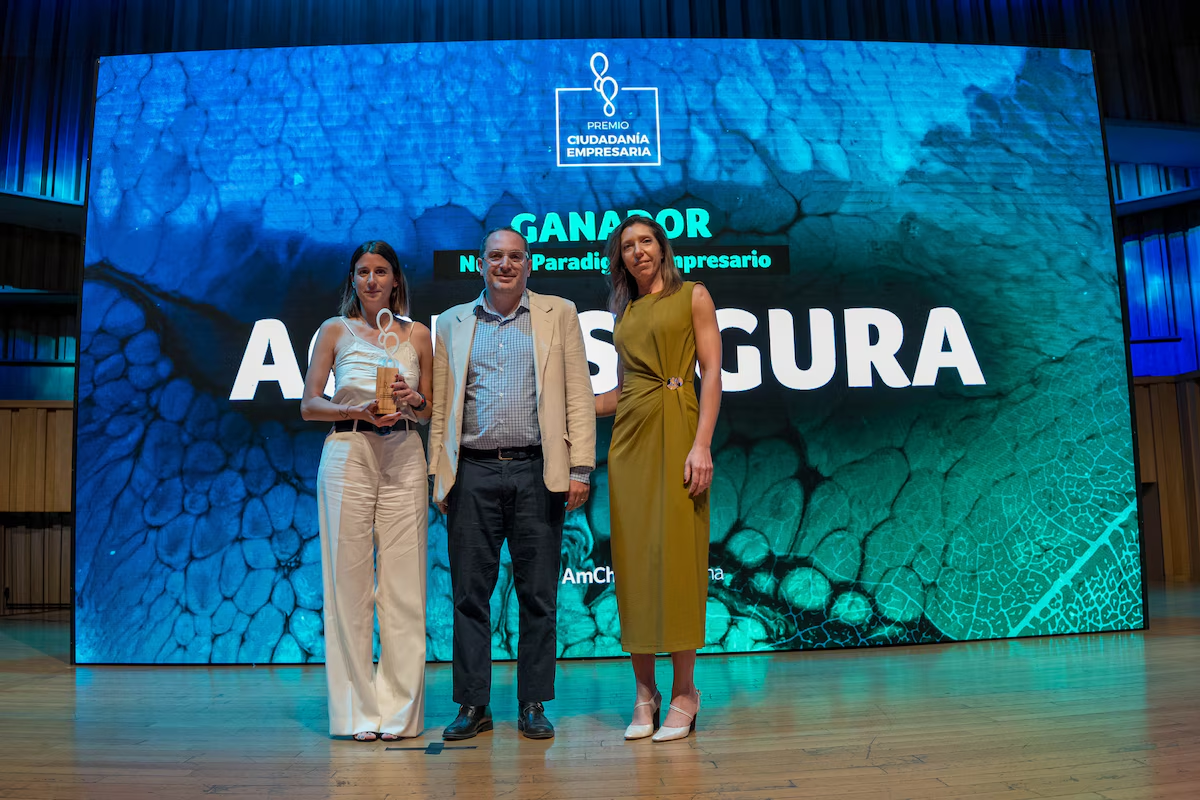
Agua Segura Receives the “New Business Paradigm” Award at AmCham Argentina’s Corporate Citizenship Awards

Ensuring access to safe water in educational and rural communities is a task that requires innovation, alliances, and a deep social commitment. This sustained work has been recognized with one of the most important awards in the country: the “New Business Paradigm” Award in the 2025 edition of the Corporate Citizenship Award (Premio Ciudadanía Empresaria – PCE), organized by AmCham Argentina.

This recognition distinguishes organizations that integrate profitability, sustainability, and social impact, driving business models that contribute to a regenerative economy. For Agua Segura, receiving this award in the year we celebrate our first decade of work is a milestone that validates our mission and reaffirms our commitment to sustainable development in Latin America.

An Award that Recognizes a Model of Comprehensive Impact

The Corporate Citizenship Award (PCE) is one of AmCham’s most prestigious initiatives and a benchmark for corporate sustainability in Argentina and the region.

Since its creation in 1999, the program has received over 2,100 nominations and distinguished more than 170 companies, becoming a standard for measuring the maturity and evolution of practices related to social responsibility, environmental impact, and sustainable innovation.

The “New Business Paradigm” award celebrates those organizations that manage to integrate in a balanced way:

  • Direct and measurable social impact,
  • Sustainable economic results,
  • Responsible environmental management,
  • Scalability and innovation,
  • Business model with a regenerative vision.

For Agua Segura, this recognition confirms that it is possible to build sustainable solutions that transform realities, generate shared value, and promote equitable access to safe drinking water.

A Decade Promoting Access to Safe Water and Education

Over the last 10 years, Agua Segura has developed a comprehensive model that combines water purification technology, community education, and intersectoral articulation. Our approach is not limited to installing solutions but works on four fundamental pillars:

  1. Appropriate and Sustainable Technology: We design and install safe water access solutions adapted to schools, rural communities, and organizations. We prioritize technologies with low maintenance, high efficiency, and a long lifespan.
  2. Education and Training: We train teachers, students, and families to promote hygiene habits, water care, and responsible consumption. Education is an essential component for long-term sustainability.
  3. Public-Private Articulation: We work with companies, governments, educational institutions, and community organizations to generate scalable and replicable initiatives.
  4. Measurable Impact: Every intervention includes clear metrics linked to access, health, school attendance, reduction of waterborne diseases, and community strengthening.

This ecosystem allows us to bring concrete solutions to thousands of people every year, always guided by SDG 6: Clean Water and Sanitation, one of the most urgent challenges on the global agenda.

What Does This Award Represent for Agua Segura?

Being recognized in the “New Business Paradigm” category means that our work is integrated within an emerging vision of regenerative business, where organizations not only seek to reduce negative impacts but also to create positive and sustainable impacts over time. For our organization, this award represents:

  • Institutional validation of the impact model.
  • Greater visibility within the ecosystem of companies, foundations, and institutions committed to sustainability.
  • Opening up new strategic alliances at a national and regional level.
  • Recognition of the work of the team, communities, and allies who make every project possible.

Celebrating our tenth anniversary with this award marks a turning point in our history. It drives us to continue developing innovative initiatives, strengthening alliances, and expanding our reach so that more schools, families, and communities can access safe water.

A Vision Towards the Future: Regenerative Economy and Sustainable Solutions:

AmCham’s recognition highlights the importance of building models based on the regenerative economy, a vision in which businesses:

  • Restore, not just preserve.
  • Generate social and environmental well-being.
  • Create sustainable and measurable value.
  • Operate in collaboration with multiple sectors.

Agua Segura will continue to promote projects that integrate technology, education, and articulation to transform the present and build a future where access to safe water is a reality for everyone.

Our Commitment Continues:

This award is not a finishing point, but a new impetus to continue building solutions that promote health, education, and sustainable development throughout the region. We deeply thank AmCham Argentina and all the people, schools, communities, companies, and partners who are part of Agua Segura’s journey. We move forward, with the conviction that access to safe water changes lives.

📸 Media Coverage Our recognition at the Corporate Citizenship Awards was highlighted in important national media outlets:ards was highlighted in important national media outlets:

Share

Bringing Companies on Board the Circular Economy Train

Manuel Sauri – CEO of Agua Segura

At Agua Segura, we develop, manage, and implement water footprint mitigation projects across the continent. We’ve engaged with dozens of new communities and launched nature-based solutions and WASH (Water, Sanitation, and Hygiene) projects that have positively impacted thousands of families in the region.

For our team, the right to safe water is the driving force that pushes us to keep expanding our horizons and finding solutions to a problem that knows no borders. The water supply crisis affects nearly every corner of the planet and has been identified as the fourth greatest risk to society over the next decade. Food security, access to healthcare, soil and groundwater contamination, and the destruction of productive ecosystems are just some of the alarm bells ringing as we view the world through the lens of the “climate crisis.”

That’s why at Agua Segura, we insist on changing the way we approach the challenges of a development model that emphasizes the transformative opportunity of investing in green solutions. There’s no need to wait for change to happen elsewhere, at another time, or within large institutions. Any company that invests in water can generate a positive impact on its business model by increasing productivity, reducing commercial risks, developing secure supply chains, and strengthening both its social license to operate and its reputation.

This is the core of our company: getting global companies on board the water economy train by advising, supporting, and adapting impact programs to address the specific challenges each company faces. The power of our project lies in these strategic alliances, which help shape the society we want to live in—a world where everyone feels responsible for water and its use. Only then will it be a right accessible to all, enabling communities to thrive in safe ecosystems, while the private sector becomes a driving force for sustainable transformation and a leader in environmental stewardship.

This cooperation is already underway. The relationship between corporations and companies specializing in solutions to the socio-environmental crisis we inhabit is growing ever closer and more prosperous. Numerous projects are embracing this new understanding of the economy, where there is no business unless it is sustainable.

This overarching approach guides our strategic mission, for which we work every day, offering local solutions to global problems. We believe it sets a clear path toward reinventing the world we want to live in.

Less than 1% of the planet’s water is fit for human consumption: why water security is one of the greatest global challenges

We live on a planet covered in water. However, that image is deeply misleading.

Of the total water on Earth, about 97% is salt water, and nearly another 2% is trapped in glaciers and polar ice caps. This leaves less than 1% of freshwater available to supply more than eight billion people, sustain food production, cities, industry, and ecosystems.

That margin was already extremely limited. Today, it is under increasing pressure due to rising demand, watershed degradation, and the increasingly visible effects of climate change. In many territories, the problem is no longer just about how much water exists, but whether it is possible to access that essential resource in a safe, continuous, and sustainable way.

This context makes water security one of the primary global challenges of the 21st century.

🌍 The water crisis: a global problem with local impacts

The water crisis does not manifest the same way in every territory. In some places, it appears as extreme scarcity; in others, as contamination, supply interruptions, or inequality in access. But in all cases, it has a common denominator: increasing pressure on already fragile water systems.

Population growth, accelerated urbanization, and the intensification of productive uses have steadily increased the demand for water. Added to this is the degradation of watersheds—deforestation, soil loss, overexploitation of aquifers—and the impacts of climate change, which alter precipitation patterns and increase the frequency of droughts and floods.

In this scenario, guaranteeing safe water cannot be limited to simply increasing supply. It requires better management of that scarce 1% available by protecting sources, reducing losses, improving water quality, and strengthening local capacities for long-term sustainable management.

💧 From global diagnosis to territorial action

While the problem is global, solutions are always built at the local level, within the watershed. This is where it is decided how water is captured, distributed, used, and protected. That is why at Agua Segura, we work with a territorial approach, developing projects that combine infrastructure, technology, education, and community work.

🇧🇷 Brazil: access to safe water in contexts of urban vulnerability

In Rio de Janeiro, alongside Microsoft, we developed a project in the Vila Beira Mar community, where access to water was not stably guaranteed. In this context, water insecurity directly impacted the health, education, and quality of life of families.

The project included:

  • The installation of 15 community reservoirs.
  • The expansion of the distribution network with home connections for 70 families.
  • The delivery of 200 family water filters, as well as filters for schools and community centers.

These actions, carried out together with TETO Brasil, improved water availability and quality for more than 3,250 people while strengthening community management of the resource. In territories where every supply interruption has immediate consequences, guaranteeing safe water means reducing health risks and opening opportunities for development.

🇨🇱 Chile: safe water in a context of structural drought

In Chile, the central zone faces structural water scarcity, worsened by more than a decade of prolonged drought. In this context, access to drinking water and the reliability of existing systems become critical challenges, especially in rural communities.

Through Microsoft’s Water Positive program, we developed projects in Colina and Curacaví in collaboration with Rural Drinking Water (APR) cooperatives. The goal was to generate new water sources and improve their quality while strengthening local resource management.

The results include:

  • An estimated volumetric benefit of 4,500 m³ of water per year.
  • Direct impact on nearly 5,000 people.
  • Improvements in 14 schools.
  • WASH workshops to promote the safe and responsible use of water in drought contexts.

These projects demonstrate that water security depends not only on infrastructure but also on education, governance, and community participation.

🌎 Latin America: scalable solutions together with GRUNDFOS

A similar approach is applied to the projects we develop with GRUNDFOS in Brazil, Chile, Colombia, Mexico, and Argentina. Since 2020, these water access initiatives have reached more than 50,000 people through the implementation of 830 solutions, including:

  • Family filters.
  • Community dispensers.
  • Rainwater harvesting systems.
  • Improvements in storage and distribution.

In these contexts, every liter of safe water available has a direct impact on the health, education, and economic opportunities of communities. The scale of the challenge demands adaptable solutions that are always designed based on local reality.

🔄 Beyond volume: how water security is built

These projects show that the water crisis is not just a matter of global volume. Reducing losses, improving quality, bringing water closer to those who cannot access it, and strengthening local capacities are actions that make a difference when the resource is so limited.

Talking about water security implies:

  • Protecting and restoring watersheds.
  • Improving efficiency in productive uses.
  • Implementing nature-based solutions.
  • Committing to long-term investments with measurable impact.

When the available margin is less than 1%, every decision counts. The way we manage water today defines not only current access but the resilience of the water systems that future generations will depend on.

🌱 A shared challenge

Water does not belong to a single organization, sector, or territory. It is a shared, interconnected, and vulnerable resource. Therefore, building sustainable water security requires collaboration between communities, companies, governments, and civil society organizations.

At Agua Segura, we work to ensure that every project contributes to strengthening the entire system, from the watershed to the global stage. Because when it comes to water, sustainability is not an option: it is a condition for the future.

Dvigi: Ultrafiltration Technology for a Healthier and More Sustainable Future

Gisella Djenderedjian – General Manager of Dvigi.

Access to safe drinking water remains one of the most urgent challenges of the 21st century. Although it may seem like a guaranteed right, over 2.2 billion people worldwide lack secure access to water, and this has devastating consequences, especially in rural communities.

According to the World Health Organization (WHO), more than 485,000 people die each year from diarrheal diseases linked to the consumption of contaminated water. This reality hits women and children hardest, as they are often primarily responsible for collecting water in rural areas. This task not only exposes them to physical risks but also keeps them away from educational and work opportunities, perpetuating cycles of poverty and inequality.

Accessible Technology to Improve Water Security

In this scenario, technology presents itself as a fundamental ally in the fight to guarantee water security. In particular, ultrafiltration systems have consolidated as an effective, sustainable, and low-cost solution to improve access to water and sanitation in contexts where water infrastructure is limited or nonexistent.

This technology allows the removal of bacteria, viruses, and sediments without the need for electricity or chemicals, making it a viable tool for vulnerable communities. Furthermore, it contributes to improving water quality, which is vital for preventing waterborne diseases and improving overall well-being.

How Ultrafiltration Works

Ultrafiltration is a purification process that uses membranes with extremely small pores to remove contaminants from water. In the case of purifiers developed by Dvigi, this system is combined with activated carbon and sediment filters, achieving complete purification without removing essential minerals from the water.

“Our purifiers combine ultrafiltration technology with activated carbon and sediment filters, eliminating impurities and improving water taste. We want to be part of the solution to the global water problem,” explains Gisella Djenderedjian, General Manager of Dvigi.

These systems are designed to be simple to install, easy to maintain, and durable, making them especially suitable for communities that do not have constant access to technical services or infrastructure.

A Sustainable Approach with Community Impact

Beyond its efficiency, Dvigi’s technology has a clear focus on sustainability. By not requiring electrical energy or generating polluting waste, it aligns with principles of water conservation and sustainable water management.

In collaboration with Agua Segura, Dvigi works on filter implementation projects in rural communities across Latin America. These initiatives not only improve access to safe drinking water but also strengthen the social fabric through:

  • Awareness workshops on responsible water use.
  • Training in hygiene and healthy habits (WASH).
  • Training for the use and maintenance of the systems.
  • Promotion of corporate water responsibility by technology provider companies.

Each project is conceived as part of a comprehensive approach that prioritizes community education and long-term sustainability.

Community Projects with Real Impact

The community water projects in which Dvigi participates are designed to generate a transformative effect. Daily access to safe water implies a radical change in health, development, and life opportunities in rural communities.

Furthermore, by freeing women and girls from the responsibility of fetching water, greater access to education and economic participation is enabled, contributing to gender equality.

These projects also reinforce the communities’ resilience to the water crisis, which intensifies with phenomena such as droughts, extreme rainfall, or contamination of surface sources.

Complement to Ecosystemic Strategies

Although ultrafiltration technology operates at the household level, it is also part of a broader approach that recognizes the importance of protecting water sources. That is, it is not enough to purify water at the end of the process: it is also essential to take care of what happens in the natural environment.

Therefore, Agua Segura articulates this technological solution with other nature-based solutions for water strategies, such as:

  • The restoration of aquatic ecosystems.
  • The recharge of aquifers through soil conservation.
  • The protection of watersheds.
  • The improvement of agricultural practices to prevent contamination.

These approaches mutually reinforce each other: while the environment is preserved, immediate tools are provided to ensure safe consumption in homes.

Technology with Purpose

“Our commitment is to improve the quality of life in the regions that need it most, using sustainable technology that transforms access to water,” says Djenderedjian.

Dvigi’s mission is clear: to make access to safe water not a privilege, but a right accessible to everyone. Each installed filter represents an opportunity to break the cycle of disease and exclusion.

In contexts where investment in traditional infrastructure takes years or is unfeasible, these technologies represent immediate, effective, and low-environmental-impact solutions for household water replenishment.

Conclusion: Innovation for the Right to Water

The water crisis demands multiple responses, from ecosystem restoration to the development of appropriate technologies for each reality. Dvigi’s experience demonstrates that social and technological innovation can be part of a comprehensive, people-centered solution.

Ultrafiltration systems not only purify water: they open doors to health, education, and community development. In partnership with organizations like Agua Segura, this technology transforms into a tool to build a fairer, more resilient, and healthier future for all.

Earth Day: why water security depends on climate, ecosystems and territory

Every April 22nd, Earth Day is celebrated, a date that invites us to reflect on the relationship between the natural systems that sustain life and the decisions we make as a society to protect them. In this context, talking about the planet also implies talking about water. Not only because it is an essential resource for health, production, and development, but because today scientific evidence shows that water is at the center of many of the most urgent environmental challenges of our time.

At Agua Segura, we understand that water security cannot be addressed as an isolated issue. Water is not a resource independent of the rest of the system. Its availability, quality, and resilience depend directly on the state of ecosystems, the health of watersheds, land use, and how climate change is altering natural cycles.

Therefore, Earth Day is a key opportunity to broaden the conversation: protecting the planet also means protecting the systems that make water possible.

Water at the center of the climate crisis

For a long time, water management was treated as a technical or sectoral issue. However, today that perspective is no longer enough. The Intergovernmental Panel on Climate Change (IPCC), the main international body of the United Nations for assessing climate science, warns that more than 50% of the impacts of climate change manifest through water.

This means that many of the most visible and serious consequences of the climate crisis appear in the form of:

  • prolonged droughts,
  • extreme rain events and floods,
  • alterations in hydrological cycles,
  • increasing variability in water availability,
  • pressure on agricultural, urban, and ecosystem systems.

In other words, water is one of the main vehicles through which climate change impacts communities, territories, and economies.

This reality redefines the concept of water risk. It is no longer just about scarcity or access. It also involves understanding how the climate modifies the functioning of the water system as a whole and how that affects the stability of watersheds, food production, infrastructure, and the resilience of communities.

The deterioration of the planet is also a water crisis

To this scenario is added another equally critical dimension: the degradation of ecosystems. The United Nations Environment Programme (UNEP) warns that more than 75% of the planet’s land surface presents some degree of degradation.

This data does not only talk about loss of biodiversity or environmental deterioration. It also talks about water.

When soils degrade, when forests disappear, when wetlands are altered, or when recharge areas lose functionality, territories lose their natural capacity to:

  • infiltrate water,
  • retain moisture,
  • regulate flows,
  • recharge aquifers,
  • buffer extreme events,
  • filter and improve water quality.

This means that the problem is not only how much water is available, but whether the natural system that produces, regulates, and distributes it is still functioning.

And that is one of the most important keys to understanding the current water crisis.

Water security cannot be thought of in isolation

Frente a este contexto, se vuelve evidente que la seguridad hídrica no puede construirse con una mirada fragmentada. No alcanza con medir consumo, optimizar una operación o instalar infraestructura si no se comprende el estado del territorio y la capacidad real de la cuenca para sostener el recurso.

Water security requires an integral vision that articulates at least four fundamental dimensions:

  1. Water management This implies improving efficiency, reducing losses, protecting sources, optimizing productive uses, and ensuring access to safe and continuous water.
  2. Ecosystem restoration Healthy ecosystems are part of the natural water infrastructure. Restoring forests, wetlands, soils, peatlands, or degraded areas strengthens the territory’s capacity to regulate water.
  3. Climate adaptation In a scenario of greater water uncertainty, it is necessary to design solutions that increase resilience against droughts, floods, and climate variability.
  4. Land use and territorial management Decisions on agriculture, urbanization, conservation, and productive development directly impact the functioning of watersheds.

Therefore, talking about sustainable water security necessarily implies integrating water, climate, biodiversity, and territory into the same strategy.

Water is not an isolated resource: it is the result of a complex system

One of the most important ideas that should guide the conversation on sustainability today is that water does not exist in isolation. It is not simply a available resource that is extracted, used, and replaced.

Water is the result of a complex system where the following intervene:

  • climate,
  • vegetation cover,
  • soil health,
  • biodiversity,
  • the infiltration capacity of the territory,
  • watershed governance,
  • productive and urban decisions.

When one of those components fails, the water system weakens.

This explains why in many territories the water crisis is not just a matter of scarcity. It is a matter of systemic degradation.

And it also explains why isolated solutions—focused solely on infrastructure or efficiency—often fall short of solving the underlying problems.

Protecting the Earth is also protecting water

Earth Day reminds us that environmental challenges are deeply connected. You cannot talk about climate change without talking about water. You cannot talk about biodiversity without talking about watersheds. You cannot talk about resilience without considering how natural systems that sustain the water cycle are protected and restored.

Caring for the planet also means:

  • protecting and restoring ecosystems,
  • reducing soil degradation,
  • strengthening watershed management,
  • implementing nature-based solutions,
  • innovating with measurable impact,
  • promoting sustainable territorial decisions.

At Agua Segura, we believe that acting against the water crisis requires a systemic, collaborative, and evidence-based approach. It means working not only on the resource, but on the system that makes it possible.

Innovate and act to build water resilience

In a context of water stress, climate change, and environmental degradation, action can no longer wait. The conversation on sustainability must move from diagnosis towards the implementation of concrete solutions.

That implies:

  • innovating with purpose,
  • measuring impact in the territory,
  • designing watershed-based strategies,
  • integrating ecological restoration and water management,
  • building alliances between communities, companies, and organizations.

The water resilience of the future will depend on our ability to understand that water does not protect itself. It is protected when we care for the territory, ecosystems, and the relationships that sustain its cycle.

Earth Day: an opportunity to rethink water

Every April 22nd, Earth Day reminds us that the planet functions as an interdependent system. And in that system, water occupies a central place.

Talking about water today is no longer just talking about availability. It is talking about water security, climate change, ecosystem restoration, biodiversity, territorial management, and resilience.

Because water is not an isolated resource.

It is the result of a complex system.

And protecting the Earth also means protecting the water.

This Earth Day, we renew a conviction that guides our work: water security is only possible when we act on the entire system, with integral solutions, collaboration, and a long-term vision.

by aguasegura.com

💧World Water Day: Why Access to Water Strengthens Food Security and the Role of Rural Women

Every March 22nd, World Water Day invites us to reflect on a resource essential for life, health, ecosystems, and development. However, when we talk about water, the debate often centers solely on domestic access or infrastructure. While these issues are fundamental, water also sustains something equally vital: the ability to produce food and support entire communities.

In many regions of the world, access to water defines more than just daily life. It also determines who can plant, produce, sustain a family economy, and remain resilient in the face of the climate crisis. In this context, the link between water, agriculture, gender, and food security becomes increasingly evident.

At Agua Segura, we believe that speaking about water security implies looking at the entire system: access to water, watershed management, territorial resilience, and the impact water has on production, local development, and individual opportunities.

🌍 Water as the Foundation of Food Production

Water is one of the most decisive resources for agriculture. Without reliable and sustainable access to water, there is no stable production, no capacity to adapt to droughts, and no resilient food systems.

Globally, the agricultural sector is responsible for approximately 70% of freshwater use, demonstrating just how interconnected water and food production truly are. But this relationship isn’t just about volume; it’s about how water is managed, who can access it, what technologies are available, and how prepared communities are to face water scarcity scenarios.

In a context of increasing water stress, watershed degradation, and climate change, access to water for agriculture becomes a key condition to:

  • Strengthen food security.
  • Improve the climate resilience of production systems.
  • Reduce the vulnerability of rural communities.
  • Expand economic opportunities in agricultural territories.
  • Promote more efficient and sustainable production.

That is why, when we speak of safe water, we are not just talking about human consumption. We are also talking about the possibility of sustaining livelihoods, local production, and territorial development.

👩‍🌾 Women and Water: A Key Relationship for Food Security

The gender dimension is central to this conversation. According to the FAO, women represent approximately 43% of the global agricultural labor force. Furthermore, in many countries, they produce between 60% and 80% of all food.

Despite this fundamental role, rural women continue to face significant barriers in accessing:

  • Land and productive resources.
  • Financing and technical assistance.
  • Agricultural technology.
  • Irrigation systems.
  • Water storage and distribution infrastructure.

When water is scarce, these inequalities deepen. In contexts of water crisis, many women must dedicate more time to securing water for their homes, reducing their production possibilities or facing greater difficulties in sustaining crops, livestock, and family economies. This impacts not only their economic autonomy but also the food security of their communities.

Therefore, improving access to water is also a way to reduce structural gaps and strengthen the role of women in rural production systems.

🌱 Access to Water: Much More Than Resource Availability

Access to water is not limited to the physical existence of the resource. It also implies having the actual conditions to use it safely, efficiently, and sustainably.

This includes:

  • Adequate infrastructure.
  • Efficient irrigation systems.
  • Safe storage.
  • Protection and restoration of watersheds.
  • Local water governance.
  • Training and technical support.

In other words, improving access to water is not just about increasing supply, but about building more resilient, equitable, and sustainable systems.

A key figure highlights this: according to the FAO, if female farmers had the same access to productive resources as men, agricultural production could increase significantly—with estimates in some contexts reaching up to a 30% improvement in productive outcomes.

This data proves something fundamental: investing in water, infrastructure, technology, and equitable access does not just improve resource management. It can also transform production systems, strengthen rural economies, and contribute to greater global food security.

🌎 Water, Climate Resilience, and Rural Development

Climate change is intensifying water-related challenges. Prolonged droughts, extreme rainfall, precipitation variability, and ecosystem degradation are altering how rural communities produce food and manage their territories.

In this scenario, water becomes a decisive factor for climate resilience. When a community has access to safe water, adequate irrigation, efficient practices, and strengthened local governance, it improves its capacity to:

  • Adapt to periods of scarcity.
  • Sustain agricultural production.
  • Reduce losses.
  • Protect their livelihoods.
  • Make decisions based on information and planning.

For this reason, water is also an opportunity: an opportunity to build more resilient territories, more stable rural economies, and communities better prepared for climate uncertainty.

💧 Water Security with a Territorial and Social Focus

At Agua Segura, we work with the conviction that water security is not built through infrastructure alone. It requires an integrated approach that coordinates: Water, Production, Territory, Community, Education, Sustainability, and Equity.

Every watershed has its own dynamics, challenges, and opportunities. Therefore, solutions must be designed from the territory up, with local participation and a focus on measurable impact. When access to water improves, we are protecting more than just a resource; we are strengthening the possibilities to produce, sustain local economies, reduce inequalities, and build a more resilient future.

🌍 World Water Day: A Date to Expand the Conversation

World Water Day, commemorated every March 22nd, is an opportunity to remember that water is not just a natural resource: it is the foundation of life, health, production, and development.

It is also an opportunity to expand the conversation. To talk about water is to talk about food security, rural women, climate resilience, sustainable watershed management, and opportunities for communities.

Because when water is missing, it doesn’t just affect daily consumption. It weakens production systems, deepens inequalities, and limits people’s ability to build a better future. Conversely, when access to water improves, communities are strengthened, production is protected, and real conditions for a fairer and more sustainable development are created.

This March 22nd, we reaffirm one conviction: water also sustains communities, and guaranteeing its access is a key condition for food security and the resilience of our future.

Less than 1% of the planet’s water is fit for human consumption: why water security is one of the greatest global challenges