
Receive the latest updates and news with our newsletter

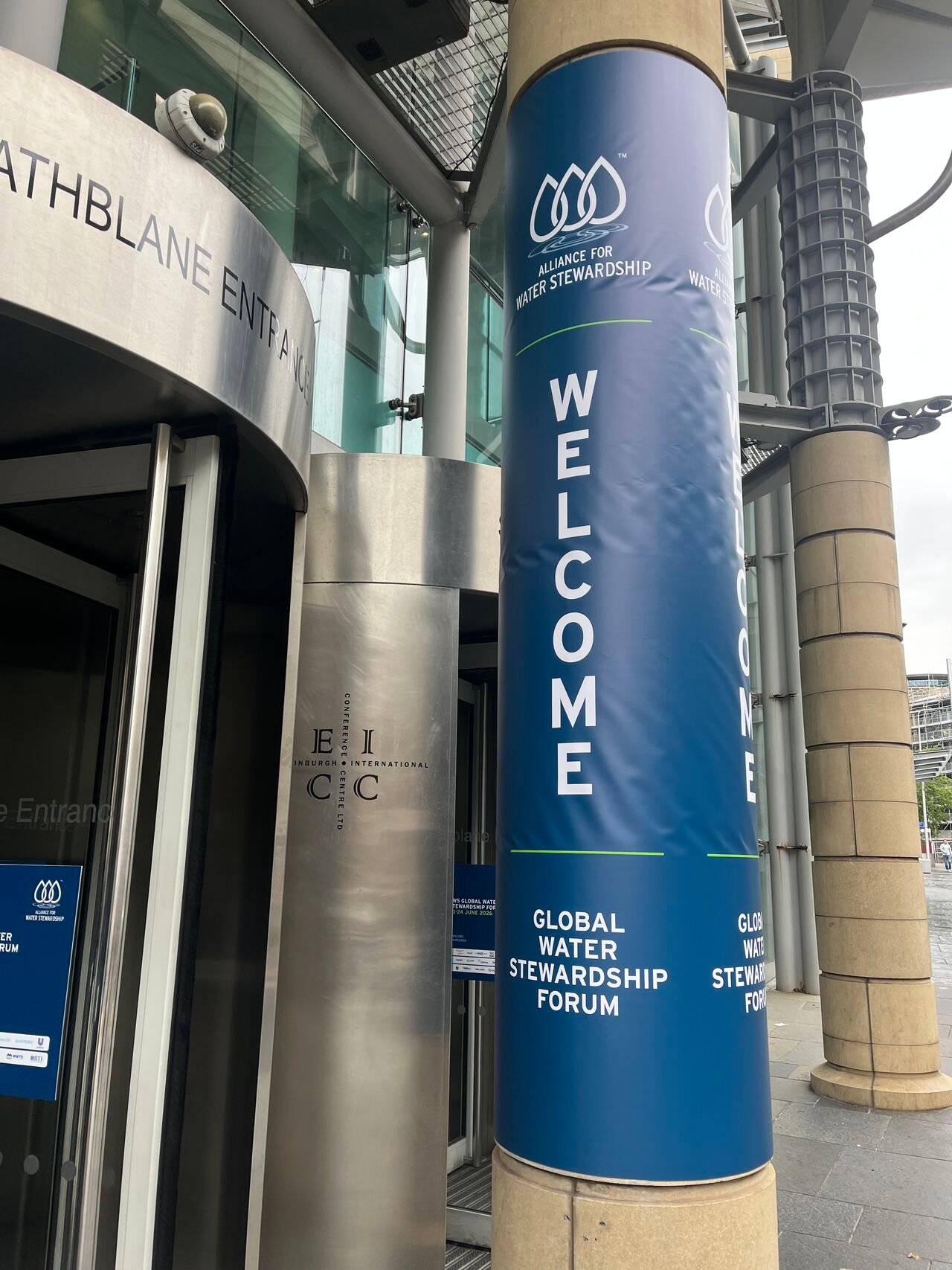
Alliance for Water Stewardship Global Water Stewardship Forum entrance at Edinburgh International Conference Centre

World Environment Day: Why Plastic Is Also a Water Crisis

Every June 5th, the world pauses for a moment to remember something that should be self-evident: the planet we inhabit has limits. World Environment Day, led by the United Nations Environment Programme (UNEP), is an opportunity to put the most urgent environmental challenges on the agenda and call for collective action.

This year, at Agua Segura, we want to highlight a connection that often goes unnoticed: the relationship between plastics and the water crisis. A relationship that is not metaphorical. It is chemical, ecosystemic, and deeply territorial.

Plastic doesn’t disappear. It breaks down and reaches the water

When plastic is not properly managed, it doesn’t disappear. It fragments into increasingly smaller particles — known as microplastics — that end up in rivers, watersheds, aquifers, and oceans. According to UNEP data, between 9 and 14 million tons of plastic enter the ocean every year. But the problem doesn’t start or end at sea.

Microplastics have been found in drinking water sources, agricultural soils, fish tissue, and human blood. They affect aquatic biodiversity, disrupt the natural cycles of ecosystems, and compromise the quality of water that entire communities depend on to live, produce, and develop.

The plastic crisis and the water crisis are not two separate problems. They are two symptoms of the same production and consumption model that ignores the natural limits of the planet.

Water security and biodiversity: an interdependent system

At Agua Segura, we work with this reality on the ground every day. We know that water security cannot be guaranteed by infrastructure alone. It depends on healthy ecosystems, functioning watersheds, soils that absorb water effectively, and communities with the capacity to care for and manage this resource.

When ecosystems become contaminated — with plastics, agrochemicals, or industrial waste — that chain breaks down. Wetlands lose their retention capacity. Degraded soils no longer filter as they once did. Communities that rely on surface or groundwater sources are left exposed.

That is why talking about the environment on June 5th is also talking about water. And talking about water means talking about the natural systems that sustain it: forests, wetlands, soils, rivers, aquifers. All of them threatened, among other things, by plastic pollution.

What can companies do?

Organizations have a role that cannot be delegated. Not only because plastic and water are part of their value chains, but because they have the capacity to scale solutions that go beyond their own operations.

This year, together with Unplastify, we developed a series of special proposals for corporate teams looking to engage with this agenda in a concrete, meaningful, and transformative way:

Inspirational talk: a awareness session on the impact of plastics on water, nature, and communities. Ideal for building internal awareness and opening conversations about sustainability within teams.

Solution design workshop: a participatory dynamic for co-creating concrete responses to plastic and water challenges. An activity that combines creativity, collaboration, and purpose.

Clean-up day: a collective action experience in contact with urban nature. Because change is also built with our hands.

These proposals are not just team-building activities. They are opportunities for organizations to integrate the environmental agenda from within, with teams that understand the problem, commit to the solution, and build a culture of sustainability.

June 5th is a date. The commitment is permanent

World Environment Day serves an important function: it raises visibility. But the environmental crisis has no expiration date and cannot be resolved with a single awareness event. It requires strategic decisions, sustained investment, and the willingness to change production and consumption models that have carried decades of inertia.

At Agua Segura, we believe that companies that understand this have a real competitive advantage: they build resilience before scarcity forces them to. They design solutions before regulators require them. They generate value for their territory before social conflict demands it.

Plastic in water is not just an environmental problem. It is an indicator of how an organization relates to the ecosystem it depends on. And changing that is possible, measurable, and necessary.

Does your company want to activate Environment Day with real impact?

Together with Unplastify, we design tailored proposals for teams that want to go beyond communication and connect with concrete environmental action. Talks, workshops, and clean-up days designed to build awareness, creativity, and commitment.

If you’re interested in exploring how we can support your organization this June 5th — and beyond — reach out to schedule a call. We’re here to help you design a water and environmental impact strategy that makes sense for your company and your territory.

Contact us at aguasegura.com and let’s talk.

#WorldEnvironmentDay #Plastics #WaterSecurity #WaterStewardship #Sustainability #ESG #AguaSegura #Environment #SDG6 #Biodiversity

Share

Allies: Working for Socio-environmental Impact

Catalina Deluchi – Vice President of Global Business Development

The socio-ecological transition poses a significant challenge for all sectors of the economy striving to adapt to more sustainable development models in this changing era.

While there is broad consensus on the need to implement business models that can mitigate and even reverse the damage done to the environment and people, many companies still struggle to find solutions that genuinely have an impact.

That’s why, when executing any project, it is crucial to understand the unique contribution that specialized companies and projects can offer. Designing a socio-environmental impact strategy with a partner who brings expertise and support to the company is a strategic decision that helps tailor solutions to the problems at hand.

At Agua Segura, we have partnered with major corporations seeking our specialized knowledge in developing programs tailored to the needs of both the companies and the communities they are part of. In this collaboration, we see ourselves as “fellow travelers,” as promoting solutions that positively impact the planet is at the core of our mission.

These strategic alliances embody a spirit of cooperation and mutual growth, and they are part of a new generation of entrepreneurs who believe in the need to rethink our production methods. The benefits of positioning companies as leaders in their communities are becoming increasingly visible, alongside cost savings and enhanced competitive advantages.

The water crisis presents a top-priority challenge for many companies looking to address their water footprint, and they are acutely aware of the urgency of this issue. No longer do multinational corporations need to be convinced that approaches considering social and environmental impact throughout the entire production chain are essential for business growth.

Therefore, the added value is not only in terms of reputation but also in the collective benefit of sustaining a project that can support long-term development within a community. On this path of social responsibility and transformative action, we accompany our partners, bringing our full expertise and knowledge to the table.

Cooperation and strategic alliances with companies that are experts in addressing the socio-environmental challenges we face today allow us to co-create an economically sustainable model for both the present and the future.

A Year of Learning, Impact, and Vision: Highlights from 2025 at Agua Segura

We are closing out a 2025 that challenged us on multiple levels: environmental, economic, and social. It was a year that pushed us to adapt, to make difficult strategic decisions, to be creative in our execution, and, above all, to reaffirm our commitment to water security and the communities we support. Every project deployed, every community strengthened, and every step forward toward equitable access to safe water, water governance, and watershed health demonstrated that the path we have chosen is the right one.

Adaptation, Strategy, and Tangible Results

This year demanded more from us than ever: creativity, resilience, and operational excellence. Climate change and its consequences—ranging from extreme droughts to unpredictable weather events—driven us to rethink our approaches and prioritize solutions tailored to the local context.

We adjusted our strategies, optimized resources, and most importantly: we learned. We learned to look beyond the short term, to strengthen ties with communities, to further professionalize our processes, and to build indicators that reflect the true impact of our work. As a result, we achieved greater operational capacity, stronger teams, and a clearer vision for the future.

Projects that Left a Mark

Throughout 2025, we implemented community water projects focused on access, resource quality, and sustainability. From filtration and water treatment technologies in rural schools to watershed conservation actions, every initiative was designed alongside local partners and with the active participation of the communities.

We also expanded our work in WASH (Water, Sanitation, and Hygiene), integrating education, infrastructure, and community engagement to achieve lasting changes in habits and sanitary conditions.

Innovation with Purpose

Innovation was a cross-cutting pillar of our work. In 2025, we accelerated the use of technological tools for water quality monitoring, developed more efficient aquifer recharge processes, and delved deeper into nature-based solutions as a response to the water crisis.

Additionally, we incorporated new processes for sustainable water management, traceability, and impact assessment—all of which are key to building projects that truly improve people’s lives.

Partnerships as the Engine of Change

None of this would be possible without our collaboration ecosystem. In 2025, we strengthened our alliances with local governments, foundations, companies, and social organizations. We share a common vision with them: that access to safe water is not just a necessity, but a fundamental human right and a vital tool for development.

Challenges brought us together, and thanks to that mutual trust, we were able to respond faster, implement more efficiently, and generate a greater impact.

Looking Ahead to 2026: A Clear Vision, a Renewed Commitment

We know that 2026 will bring new challenges. But it also finds us better prepared. In this upcoming year, we will:

  • Scale our impact to reach more rural and urban communities.
  • Strengthen our alliances across all sectors.
  • Accelerate innovation, especially in low-cost, high-effectiveness projects.
  • Continue building trust and transparency with those who support us.

We are driven by the conviction that we build comprehensive water solutions with high social, environmental, and economic value—solutions that adapt to the context and can be sustained over time.

To Those Who Walk Alongside Us

To our team, our partners, the communities we work with, and every person who believes in our purpose: thank you for being a part of this journey.

Impact is built together, with vision, commitment, and action.

Happy New Year!

🎥 Watch our 2025 video recap

Making the Invisible Visible-Agua Segura

By Manuel Sauri – CEO of Agua Segura

When we think about the importance of water for our lives and development, we surely imagine the rivers, seas, and lakes that feed us, provide energy, and recreation. If we go a bit further, perhaps we reflect on the importance of wetlands and ecosystems that work to mitigate the effects of climate change. But there is a place where practically all the planet’s liquid fresh water is concentrated: beneath the earth.

Groundwater has enormous significance for human society. Its sustainable management and protection are essential to guarantee water security, food production, drinking water supply, and the health of ecosystems.

Groundwater: the invisible resource that sustains life

Access to safe water is a fundamental human right. We only need to remember the “water cycle” we learned in school to understand that what we do on the surface directly affects what happens beneath it. If the water circulation process is interrupted, terrestrial ecosystems lose their balance, and with them, aquifers deteriorate.

According to UNESCO data, over 95% of the world’s available liquid freshwater is groundwater, and it is estimated that 50% of the world’s population depends on it for domestic consumption.

These natural reservoirs supply not only our homes but also sanitation systems, industries, and, above all, the agricultural sector.

Agriculture and Aquifers: A Critical Relationship

Agriculture is the largest consumer of freshwater on the planet. According to the FAO, about 40% of the water used for irrigation globally comes from aquifers. And it is estimated that to feed a global population of 9 billion by 2050, food production must increase by 60%.

However, the excessive use of groundwater for irrigation can lead to its depletion, reduced river flow, and loss of wetlands. Furthermore, if they become contaminated with agrochemicals, fertilizers, or other substances, their quality is jeopardized, and negative impacts on public health are generated.

Sustainable water management in agriculture is crucial. Adopting efficient irrigation technologies, improving soil infiltration, and reducing chemical use are key steps to protect this invisible resource.

Groundwater Conservation and Recharge of Aquifers

Aquifer recharge is the natural process by which rainwater or river water slowly penetrates the soil and reaches underground layers. But when areas are deforested, soils are compacted, or urbanization occurs without planning, this process is interrupted.

At Agua Segura, we promote nature-based solutions that allow us to recover this natural absorption capacity: soil restoration, reforestation of watersheds, wetland conservation, and rainwater harvesting systems.

These actions are part of integrated watershed management strategies aimed at strengthening the water resilience of territories.

Groundwater and Climate Change

Groundwater plays an important role in mitigating climate change. By maintaining stable river levels, they sustain ecosystems during droughts. They also prevent saltwater intrusion in coastal areas, protecting freshwater reserves against rising sea levels.

However, the water crisis has exacerbated aridity in regions where the only source of supply is groundwater. There, sustainable management is not an option; it is a vital necessity.

Water Quality: A Silent Challenge

In addition to depletion, groundwater contamination is a serious challenge. Chemical substances such as nitrates, pesticides, heavy metals, or hydrocarbons can slowly infiltrate and remain for years, affecting water quality without being detected.

Implementing monitoring systems, improving land use planning, and promoting corporate water responsibility are necessary measures to prevent this deterioration.

Making the Invisible Visible

Groundwater knows no borders. Therefore, its preservation requires a global, collaborative, and long-term perspective. According to UN Water, we need public policies, investments, and citizen participation to face emerging challenges.

We also need education and communication. Because making the invisible visible means teaching that what happens beneath our feet sustains everything that happens on the surface. And that without groundwater, there is no agriculture, no industry, no health.

The Basis of All Sustainable Development

Groundwater is a hidden treasure that we must care for, monitor, and manage responsibly. They not only guarantee access to water and sanitation (WASH), but they are also the basis of any sustainable development strategy that aspires to be just, resilient, and lasting.

Conclusion

We are facing a key resource for life. Invisible for decades, it now demands to be at the center of policies, investments, and collective consciousness.

Making the invisible visible is recognizing the infinite value of our groundwater. And acting accordingly.

World Environment Day: Why Plastic Is Also a Water Crisis

Every June 5th, the world pauses to acknowledge something that should be self-evident: the planet we inhabit has limits. World Environment Day, led by the United Nations Environment Programme (UNEP), is an opportunity to bring the most urgent environmental challenges onto the agenda and call for collective action.

This year, at Agua Segura, we want to address a connection that often goes unnoticed: the relationship between plastics and the water crisis. A relationship that is not metaphorical. It is chemical, ecosystemic and deeply territorial.

Plastic Does Not Disappear. It Fragments and Reaches Our Water

When plastic is not properly managed, it does not disappear. It breaks down into increasingly smaller particles — known as microplastics — which end up in rivers, watersheds, aquifers and oceans. According to UNEP data, between 9 and 14 million tons of plastic enter the ocean every year. But the problem does not begin or end at sea.

Microplastics have been found in drinking water sources, agricultural soils, fish tissue and human blood. They affect aquatic biodiversity, disrupt the natural cycles of ecosystems and compromise the water quality that entire communities depend on to live, produce and develop.

The plastic crisis and the water crisis are not two separate problems. They are two symptoms of the same model of production and consumption that ignores the natural limits of the planet.

Water Security and Biodiversity: An Interdependent System

At Agua Segura we work with this reality on the ground every day. We know that water security cannot be guaranteed by infrastructure alone. It depends on healthy ecosystems, functional watersheds, soils with strong infiltration capacity and communities with the ability to care for and manage the resource.

When ecosystems become contaminated — by plastics, agrochemicals or industrial waste — that chain breaks down. Wetlands lose their retention capacity. Degraded soils no longer filter as they once did. Communities that depend on surface or groundwater sources become vulnerable.

That is why talking about the environment on June 5th also means talking about water. And talking about water means talking about the natural systems that sustain it: forests, wetlands, soils, rivers and aquifers. All of them threatened, among other things, by plastic pollution.

What Can Companies Do?

Organizations have a role that cannot be delegated. Not only because plastic and water are part of their value chains, but because they have the capacity to scale solutions that reach far beyond their own operations.

This year, together with Unplastify, we developed a series of special proposals for corporate teams looking to engage with this agenda in a concrete, meaningful and transformative way:

Inspirational talk: a awareness session on the impact of plastics on water, nature and communities. Ideal for building internal awareness and opening sustainability conversations within teams.

Solutions design workshop: a participatory session to co-create concrete responses to plastic and water challenges. An activity that combines creativity, collaboration and purpose.

Clean-up day: a collective action experience in contact with urban nature. Because change is also built with your hands.

These proposals are not just team-building activities. They are opportunities for organizations to integrate the environmental agenda from within — with teams that understand the problem, commit to solutions and build a culture of sustainability.

June 5th Is a Date. The Commitment Is Permanent

World Environment Day serves an important purpose: it makes the crisis visible. But the environmental crisis has no expiration date and cannot be resolved with a single awareness event. It requires strategic decisions, sustained investment and the willingness to change production and consumption models that have decades of inertia behind them.

At Agua Segura we believe that companies that understand this have a real competitive advantage: they build resilience before scarcity forces them to. They design solutions before regulators require them. They generate value for their territory before social conflict demands it.

Plastic in water is not just an environmental problem. It is an indicator of how an organization relates to the ecosystem it depends on. And changing that is possible, measurable and necessary.

Does Your Company Want to Activate Environment Day With Real Impact?

Together with Unplastify we design tailored proposals for teams that want to go beyond communication and connect with concrete environmental action. Talks, workshops and clean-up days designed to generate awareness, creativity and commitment.

If you are interested in exploring how we can support your organization this June 5th — and beyond — reach out to coordinate a call. We are here to help you design a water and environmental impact strategy that makes sense for your company and your territory.

Contact us at aguasegura.com and let’s talk.

Earth Day: why water security depends on climate, ecosystems and territory

Every April 22nd, Earth Day is celebrated, a date that invites us to reflect on the relationship between the natural systems that sustain life and the decisions we make as a society to protect them. In this context, talking about the planet also implies talking about water. Not only because it is an essential resource for health, production, and development, but because today scientific evidence shows that water is at the center of many of the most urgent environmental challenges of our time.

At Agua Segura, we understand that water security cannot be addressed as an isolated issue. Water is not a resource independent of the rest of the system. Its availability, quality, and resilience depend directly on the state of ecosystems, the health of watersheds, land use, and how climate change is altering natural cycles.

Therefore, Earth Day is a key opportunity to broaden the conversation: protecting the planet also means protecting the systems that make water possible.

Water at the center of the climate crisis

For a long time, water management was treated as a technical or sectoral issue. However, today that perspective is no longer enough. The Intergovernmental Panel on Climate Change (IPCC), the main international body of the United Nations for assessing climate science, warns that more than 50% of the impacts of climate change manifest through water.

This means that many of the most visible and serious consequences of the climate crisis appear in the form of:

  • prolonged droughts,
  • extreme rain events and floods,
  • alterations in hydrological cycles,
  • increasing variability in water availability,
  • pressure on agricultural, urban, and ecosystem systems.

In other words, water is one of the main vehicles through which climate change impacts communities, territories, and economies.

This reality redefines the concept of water risk. It is no longer just about scarcity or access. It also involves understanding how the climate modifies the functioning of the water system as a whole and how that affects the stability of watersheds, food production, infrastructure, and the resilience of communities.

The deterioration of the planet is also a water crisis

To this scenario is added another equally critical dimension: the degradation of ecosystems. The United Nations Environment Programme (UNEP) warns that more than 75% of the planet’s land surface presents some degree of degradation.

This data does not only talk about loss of biodiversity or environmental deterioration. It also talks about water.

When soils degrade, when forests disappear, when wetlands are altered, or when recharge areas lose functionality, territories lose their natural capacity to:

  • infiltrate water,
  • retain moisture,
  • regulate flows,
  • recharge aquifers,
  • buffer extreme events,
  • filter and improve water quality.

This means that the problem is not only how much water is available, but whether the natural system that produces, regulates, and distributes it is still functioning.

And that is one of the most important keys to understanding the current water crisis.

Water security cannot be thought of in isolation

Frente a este contexto, se vuelve evidente que la seguridad hídrica no puede construirse con una mirada fragmentada. No alcanza con medir consumo, optimizar una operación o instalar infraestructura si no se comprende el estado del territorio y la capacidad real de la cuenca para sostener el recurso.

Water security requires an integral vision that articulates at least four fundamental dimensions:

  1. Water management This implies improving efficiency, reducing losses, protecting sources, optimizing productive uses, and ensuring access to safe and continuous water.
  2. Ecosystem restoration Healthy ecosystems are part of the natural water infrastructure. Restoring forests, wetlands, soils, peatlands, or degraded areas strengthens the territory’s capacity to regulate water.
  3. Climate adaptation In a scenario of greater water uncertainty, it is necessary to design solutions that increase resilience against droughts, floods, and climate variability.
  4. Land use and territorial management Decisions on agriculture, urbanization, conservation, and productive development directly impact the functioning of watersheds.

Therefore, talking about sustainable water security necessarily implies integrating water, climate, biodiversity, and territory into the same strategy.

Water is not an isolated resource: it is the result of a complex system

One of the most important ideas that should guide the conversation on sustainability today is that water does not exist in isolation. It is not simply a available resource that is extracted, used, and replaced.

Water is the result of a complex system where the following intervene:

  • climate,
  • vegetation cover,
  • soil health,
  • biodiversity,
  • the infiltration capacity of the territory,
  • watershed governance,
  • productive and urban decisions.

When one of those components fails, the water system weakens.

This explains why in many territories the water crisis is not just a matter of scarcity. It is a matter of systemic degradation.

And it also explains why isolated solutions—focused solely on infrastructure or efficiency—often fall short of solving the underlying problems.

Protecting the Earth is also protecting water

Earth Day reminds us that environmental challenges are deeply connected. You cannot talk about climate change without talking about water. You cannot talk about biodiversity without talking about watersheds. You cannot talk about resilience without considering how natural systems that sustain the water cycle are protected and restored.

Caring for the planet also means:

  • protecting and restoring ecosystems,
  • reducing soil degradation,
  • strengthening watershed management,
  • implementing nature-based solutions,
  • innovating with measurable impact,
  • promoting sustainable territorial decisions.

At Agua Segura, we believe that acting against the water crisis requires a systemic, collaborative, and evidence-based approach. It means working not only on the resource, but on the system that makes it possible.

Innovate and act to build water resilience

In a context of water stress, climate change, and environmental degradation, action can no longer wait. The conversation on sustainability must move from diagnosis towards the implementation of concrete solutions.

That implies:

  • innovating with purpose,
  • measuring impact in the territory,
  • designing watershed-based strategies,
  • integrating ecological restoration and water management,
  • building alliances between communities, companies, and organizations.

The water resilience of the future will depend on our ability to understand that water does not protect itself. It is protected when we care for the territory, ecosystems, and the relationships that sustain its cycle.

Earth Day: an opportunity to rethink water

Every April 22nd, Earth Day reminds us that the planet functions as an interdependent system. And in that system, water occupies a central place.

Talking about water today is no longer just talking about availability. It is talking about water security, climate change, ecosystem restoration, biodiversity, territorial management, and resilience.

Because water is not an isolated resource.

It is the result of a complex system.

And protecting the Earth also means protecting the water.

This Earth Day, we renew a conviction that guides our work: water security is only possible when we act on the entire system, with integral solutions, collaboration, and a long-term vision.

by aguasegura.com

💧World Water Day: Why Access to Water Strengthens Food Security and the Role of Rural Women

Every March 22nd, World Water Day invites us to reflect on a resource essential for life, health, ecosystems, and development. However, when we talk about water, the debate often centers solely on domestic access or infrastructure. While these issues are fundamental, water also sustains something equally vital: the ability to produce food and support entire communities.

In many regions of the world, access to water defines more than just daily life. It also determines who can plant, produce, sustain a family economy, and remain resilient in the face of the climate crisis. In this context, the link between water, agriculture, gender, and food security becomes increasingly evident.

At Agua Segura, we believe that speaking about water security implies looking at the entire system: access to water, watershed management, territorial resilience, and the impact water has on production, local development, and individual opportunities.

🌍 Water as the Foundation of Food Production

Water is one of the most decisive resources for agriculture. Without reliable and sustainable access to water, there is no stable production, no capacity to adapt to droughts, and no resilient food systems.

Globally, the agricultural sector is responsible for approximately 70% of freshwater use, demonstrating just how interconnected water and food production truly are. But this relationship isn’t just about volume; it’s about how water is managed, who can access it, what technologies are available, and how prepared communities are to face water scarcity scenarios.

In a context of increasing water stress, watershed degradation, and climate change, access to water for agriculture becomes a key condition to:

  • Strengthen food security.
  • Improve the climate resilience of production systems.
  • Reduce the vulnerability of rural communities.
  • Expand economic opportunities in agricultural territories.
  • Promote more efficient and sustainable production.

That is why, when we speak of safe water, we are not just talking about human consumption. We are also talking about the possibility of sustaining livelihoods, local production, and territorial development.

👩‍🌾 Women and Water: A Key Relationship for Food Security

The gender dimension is central to this conversation. According to the FAO, women represent approximately 43% of the global agricultural labor force. Furthermore, in many countries, they produce between 60% and 80% of all food.

Despite this fundamental role, rural women continue to face significant barriers in accessing:

  • Land and productive resources.
  • Financing and technical assistance.
  • Agricultural technology.
  • Irrigation systems.
  • Water storage and distribution infrastructure.

When water is scarce, these inequalities deepen. In contexts of water crisis, many women must dedicate more time to securing water for their homes, reducing their production possibilities or facing greater difficulties in sustaining crops, livestock, and family economies. This impacts not only their economic autonomy but also the food security of their communities.

Therefore, improving access to water is also a way to reduce structural gaps and strengthen the role of women in rural production systems.

🌱 Access to Water: Much More Than Resource Availability

Access to water is not limited to the physical existence of the resource. It also implies having the actual conditions to use it safely, efficiently, and sustainably.

This includes:

  • Adequate infrastructure.
  • Efficient irrigation systems.
  • Safe storage.
  • Protection and restoration of watersheds.
  • Local water governance.
  • Training and technical support.

In other words, improving access to water is not just about increasing supply, but about building more resilient, equitable, and sustainable systems.

A key figure highlights this: according to the FAO, if female farmers had the same access to productive resources as men, agricultural production could increase significantly—with estimates in some contexts reaching up to a 30% improvement in productive outcomes.

This data proves something fundamental: investing in water, infrastructure, technology, and equitable access does not just improve resource management. It can also transform production systems, strengthen rural economies, and contribute to greater global food security.

🌎 Water, Climate Resilience, and Rural Development

Climate change is intensifying water-related challenges. Prolonged droughts, extreme rainfall, precipitation variability, and ecosystem degradation are altering how rural communities produce food and manage their territories.

In this scenario, water becomes a decisive factor for climate resilience. When a community has access to safe water, adequate irrigation, efficient practices, and strengthened local governance, it improves its capacity to:

  • Adapt to periods of scarcity.
  • Sustain agricultural production.
  • Reduce losses.
  • Protect their livelihoods.
  • Make decisions based on information and planning.

For this reason, water is also an opportunity: an opportunity to build more resilient territories, more stable rural economies, and communities better prepared for climate uncertainty.

💧 Water Security with a Territorial and Social Focus

At Agua Segura, we work with the conviction that water security is not built through infrastructure alone. It requires an integrated approach that coordinates: Water, Production, Territory, Community, Education, Sustainability, and Equity.

Every watershed has its own dynamics, challenges, and opportunities. Therefore, solutions must be designed from the territory up, with local participation and a focus on measurable impact. When access to water improves, we are protecting more than just a resource; we are strengthening the possibilities to produce, sustain local economies, reduce inequalities, and build a more resilient future.

🌍 World Water Day: A Date to Expand the Conversation

World Water Day, commemorated every March 22nd, is an opportunity to remember that water is not just a natural resource: it is the foundation of life, health, production, and development.

It is also an opportunity to expand the conversation. To talk about water is to talk about food security, rural women, climate resilience, sustainable watershed management, and opportunities for communities.

Because when water is missing, it doesn’t just affect daily consumption. It weakens production systems, deepens inequalities, and limits people’s ability to build a better future. Conversely, when access to water improves, communities are strengthened, production is protected, and real conditions for a fairer and more sustainable development are created.

This March 22nd, we reaffirm one conviction: water also sustains communities, and guaranteeing its access is a key condition for food security and the resilience of our future.